GBS and Alternative Remedies and Treatments

About three months ago Marti from Group B Strep International asked if I would be interested in writing up something about all the various “alternative remedies” and “alternative treatments” for GBS and how effective they were.

I said “sure!” And here it is, 3 months later (also available as a 1-page word doc):

Group B Strep and Alternative Remedies

The CDC has a clear protocol for treating GBS in pregnancy; test every pregnant woman for the presence of the bacterium at 35-37 weeks and if found administer an antibiotic IV when water breaks or labor begins.

This is the only treatment that the CDC has found to be effective against GBS, but it works very well. There are two reasons why.

1. Group B Strep Comes Back

GBS is everywhere in our environment. Until a GBS vaccine is developed, it is impossible to eradicate it permanently. GBS colonization will often return to a healthy woman within just hours of using antibiotics.

2. Group B Strep Is Weak

GBS is not a particularly “strong” bacteria. Although many people are colonized, only those with very weak immune systems actually get infected.

This is why the only effective technique against early-onset GBS infection in newborns is an intrapartum antibiotic IV. It eradicates GBS exactly when the baby is susceptible.

Alternative Remedies Target the Wrong Things

Unfortunately, all known alternative remedies fall into one of two equally ineffective strategies: they seek to eradicate GBS before labor (even if effective, GBS will likely return quickly), or they seek to strengthen the immune system of the mother (already plenty strong) or child (far too weak without the help of an injection of powerful antibiotics). Even when successful, they are ineffective.

The following alternative remedies are ineffective against GBS because they seek to eradicate GBS before labor and delivery (or because when used during labor and delivery, they have not been shown to work):

Oral antibiotics (penicillin, ampicillin, clindamycin, etc..)
Intramuscular antibiotics (Note: “None has proven to
be effective at preventing early-onset GBS disease.”)
Chlorhexidine bath or wipes such as Hibiclens (Note: “Randomized clinical trials have found no protection against early-onset GBS disease or neonatal sepsis.”)
Garlic capsules/suppositories, Boric Acid suppositories (Note: Target MRSA and yeast infections, respectively. Not GBS.)
Douching with hydrogen peroxide/diluted bleach water/lavender oil/yogurt (Note: douching at all is dangerous.)
Propolis (Note: Targets salmonella. Not GBS.)
Tea Tree Oil (Note: Targets staph infections and lice. Not GBS. Very toxic if swallowed.)
Apple Cider Vinegar (Note: Slightly dangerous, unregulated; no known antibiotic properties.)
Colloidal Silver (Note: “Lack of proven effectiveness and risk of adverse side-effects, such as argyria.”)

The following alternative remedies are ineffective against GBS because they seek to strengthen immune systems:

• Getting lots of sleep, keeping a good diet, and exercising.
Vitamin C and Herbal Tea
Breast feeding (Note: Colostrum helps a baby’s immune system, but unfortunately is not nearly enough to protect a newborn against GBS.)
Skin-to-skin contact (Note: Soothes newborns and promotes breastfeeding, but does not protect against GBS.)
Probiotics such as acidophilus/lactobacillus (Note: Targets digestion and bacterial vaginosis, not GBS.)
Congaplex (Note: “These products are not intended to diagnose, treat, cure or prevent any disease.”)
Echinacea (Note: “Has “no clinically significant effects” on rates of infection or duration or intensity of symptoms.”)
Grapefruit Seed Extract (Note: “Independent studies have shown the efficacy of grapefruit seed extract as an antimicrobial is not demonstrated.”)
Goldenseal Root, Oregon Grape Root, Astragalus Root, Burdock Root, and NF formula EHB (Note: You should not take any of these when pregnant!)

Another alternative some still recommend is to not test for GBS, but rather to only administer an antibiotic IV if a “high-risk” factor is present during labor. In fact, this was the CDC protocol before 2002. However, numerous studies since have shown that a much more effective protection method is to simply check for GBS directly each pregnancy. Therefore, the CDC changed their recommendation in 2002 and reiterated that recommendation in 2010.

GBS is a horrible disease that kills thousands of otherwise healthy newborns a year, and permanently disables even more. The tragedy is worsened by the fact that there is a universally available easy, cheap, and highly effective prevention method. No more babies need ever get sick or die from GBS.

(Personal note: We followed an alternative GBS regimen of acidophilus, echinacea, garlic capsules, vitamin C, grapefruit seed extract, and garlic suppositories when pregnant with our son Wren. He was 7 pounds, 20.5 inches and perfect after a normal labor and delivery at home. He breastfed then died 11 hours later from a Group B Strep infection in his lungs.)


CDC Updated GBS Guidelines

The CDC updated their GBS guidelines today.. which is a pretty big deal!

They first released their guidelines in 1996, then updated them in 2002, and now updated them again today.

The full recommendations are here.

The summary of the key changes are:

• expanded recommendations on laboratory methods for the identification of GBS,

• clarification of the colony-count threshold required for reporting GBS detected in the urine of pregnant women,

• updated algorithms for GBS screening and intrapartum chemoprophylaxis for women with preterm labor or preterm premature rupture of membranes,

• a change in the recommended dose of penicillin-G for chemoprophylaxis,

• updated prophylaxis regimens for women with penicillin allergy, and

• a revised algorithm for management of newborns with respect to risk for early-onset GBS disease.

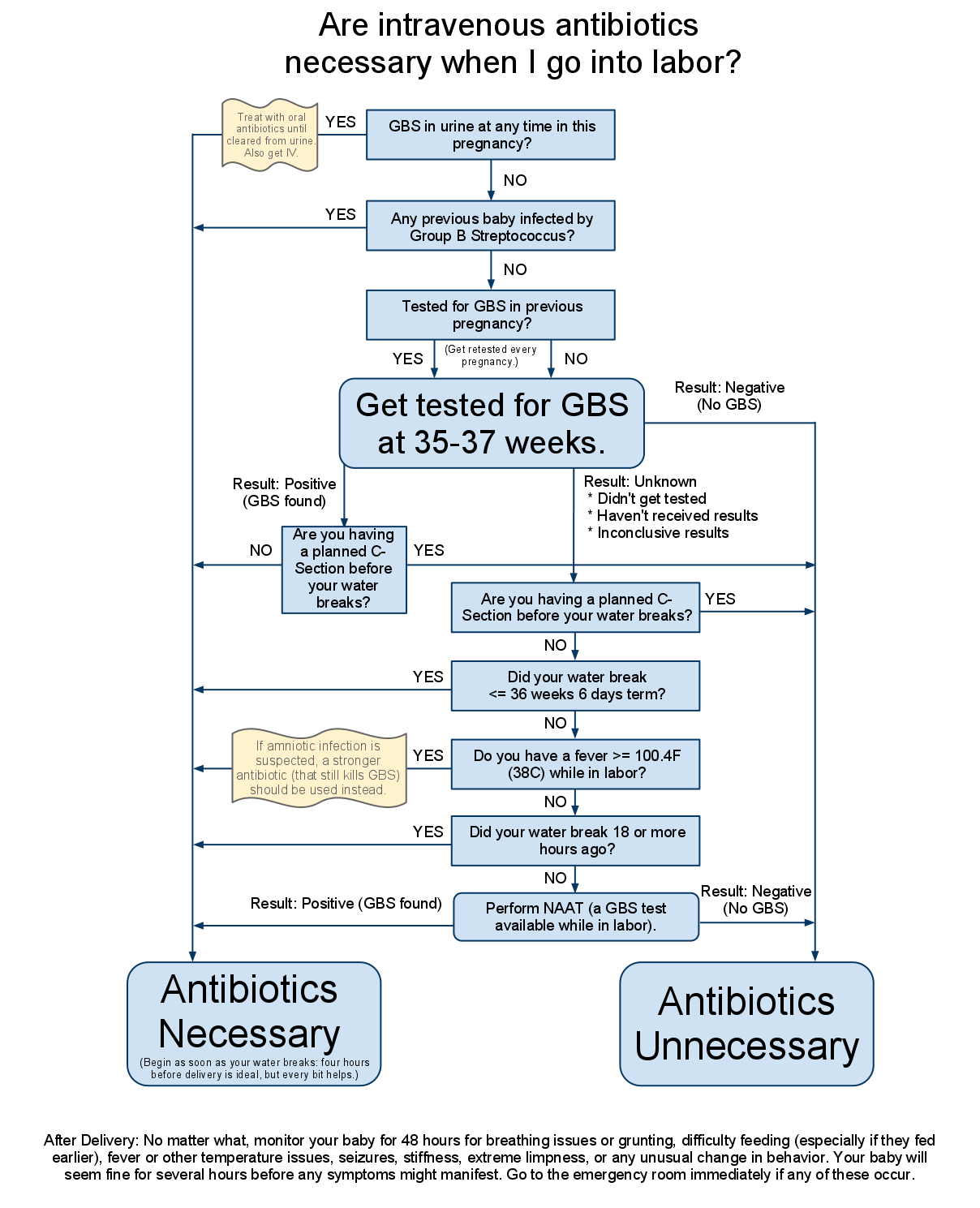
A GBS flowchart

I made this because I think the CDC one (and other’s I’ve seen) are kind of confusing. Hopefully this one is better.. it’s 100% functionally the same as the CDC recommendations.

You can download it as a PDF here too!

And don’t forget my (now recently updated) GBS frequently asked questions doc here!

GBS Information

Here’s what I’ve sort of come up with as sort of the “crucial” GBS info parents-to-be should know. Download as Word Doc (3 pages, 90K)

Group B Streptococcus (GBS) and Pregnancy

In summary:
Every mother is tested for GBS bacteria around 35-37 weeks [ 1 ] (unless GBS was already detected in a urine test, in which case further testing is unnecessary). [ 2 ] 30% of pregnant women are GBS-positive (there are typically no symptoms). [ 3 ]
2.5% of pregnant women are heavily colonized (GBS shows up in urine test). [ 4 ]

When a GBS-positive mother is given an antibiotic IV at least four hours before delivery, only 1 in 4000 babies get infected.
Without an IV, 1 in 200 babies get infected. (20 times worse) [ 5 ] For heavily-colonized mothers without an IV, 1 in 8 get infected. (500 times worse) If your GBS status is unknown when you go into labor, get an antibiotic IV.

After birth, monitor your baby for infection for 48 hours so they may be treated (they will usually seem 100% healthy and have no symptoms for the first several hours). Without treatment, GBS is nearly 100% fatal. With treatment, only 2-30% of GBS-infected newborns die. [ 6 ] 20-30% of survivors are left with speech, hearing, vision or mental problems. [ 7 ]

What is group B strep?
Group B strep (streptococcus) is a type of bacteria that can cause serious illness and death in newborns. Until recent prevention efforts, hundreds of babies died from group B strep every year. This type of bacteria can also cause illness in adults, especially the elderly, but it is most common in newborns.

How does someone get group B strep?
Anyone can be a “carrier” for group B strep. The bacteria are found in the gastrointestinal tract (guts) and may move into the vagina and/or rectum. It is not a sexually transmitted disease (STD). About 1 in 3 women carry these bacteria. Most women would never have symptoms or know that they had these bacteria without a test during pregnancy.

Why do I need to get tested for group B strep during each pregnancy?
Group B strep bacteria can be passed from a mom who is a carrier for the bacteria (tests positive) to her baby during labor. Since the bacteria can come and go in your body, you need to be tested for group B strep every time you are pregnant, whether you tested negative or positive during the last pregnancy. Toward the end of pregnancy (35-37 weeks), the doctor will swab your vagina and rectum to test for GBS.

What happens to babies born with the group B strep bacteria?
Group B strep is the most common cause of sepsis (blood infection) and meningitis (infection of the fluid and lining around the brain) in newborns. Group B strep is a frequent cause of newborn pneumonia and is more common than other, more well-known, newborn problems such as rubella, congenital syphilis, and spina bifida. Group B strep infection is fatal in up to 20% of infected newborns. Another 20% of those who survive are left with speech, hearing, or vision problems, or mental retardation.

How can group B strep disease in babies be prevented?
Most early onset group B strep disease in newborns can be prevented by giving antibiotics (medicine) through the vein (IV) during labor to women who tested positive during their pregnancy. Because the bacteria can grow quickly, giving antibiotics before labor has started does not prevent the problem. Any woman who has a positive test for group B strep during this pregnancy should get antibiotics. Also, any pregnant woman who has had a baby in the past with group B strep disease, or who now has a bladder (urinary tract) infection caused by group B strep should get antibiotics during labor. The IV will decrease your baby’s chances of getting infected 20-fold (to just 1 in 4000).

What if GBS is detected in my urine?
This means you are heavily colonized with GBS. Only about 5% of pregnant women are heavily colonized with GBS (as opposed to 30% having GBS at all). If GBS is ever detected in your urine during pregnancy, there is no need to be tested at 35-37 weeks; you definitely need to get an antibiotic IV as soon as you go into labor. Heavily colonized women have a 2,500% greater chance of passing GBS to their baby (1 in 8 chance) than a typical GBS positive woman (1 in 200). Fortunately, by getting the IV as soon as you go into labor (at least four hours before delivery), you reduce the chances that your baby becomes infected by 99.8% (to just a 1 in 4000 chance of infection).

What if I’m allergic to some antibiotics?
Women who are allergic to some antibiotics, such as penicillin, can still get other types of antibiotics. If you think you are allergic to penicillin, talk with your doctor.

Are there reasons not to get an antibiotic IV?
There is no need to get an IV if a mother is tested to be GBS-negative. However, numerous studies have determined that because of the high likelihood and terrible consequences of infection, all GBS-positive (or unknown GBS status) mothers should receive an antibiotic IV at least four hours prior to delivery.

If I know that I’m a group B strep carrier, why can’t I just take some antibiotics now?
For women who are group B strep carriers, antibiotics before labor are not a good way to get rid of group B strep. Because they naturally live in the gastrointestinal tract (guts), the bacteria often come back after antibiotic treatment. Antibiotics during labor are effective at protecting your baby because they greatly reduce the amount of bacteria the baby is exposed to during labor. Even if you had IV antibiotics for your last baby, you may not need them for this pregnancy if you are not a carrier now. Get tested every pregnancy.

What do I need to do during pregnancy or labor if I’m group B strep positive?
Talk with your doctor and create a labor plan that includes getting antibiotics for group B strep prevention in your newborn. When your water breaks, or when you go into labor, make sure to get to the hospital at least four hours before delivery to make sure there is enough time for the antibiotics to work. When you get to the hospital, remind the staff that you are group B strep positive.

What makes it more likely for my baby to catch GBS from me during labor?
* Labor before 37 weeks of pregnancy (even just one day before).
* Fever (>100.4F) during labor.
* Rupture of membranes (broken bag of water) for more than 18 hours before birth.

What should I do after my baby is born?
If you were GBS positive or had an unknown GBS status, even if you got an IV, your baby should be closely monitored for at least 48 hours for any signs of infection (they will usually seem 100% healthy and show no symptoms for several hours after birth):

* Breathing problems or grunting sounds (it may seem like a constant soft crying or “whimpering”/”wheezing”).
* Difficulty feeding, or even suckling a finger, especially if they fed earlier.
* Fever, or problems with temperature regulation.
* Seizures, stiffness, or extreme limpness.
* Unusual change in behavior.

If any of these occur, immediately go to the emergency room. Your baby can be given an antibiotic IV to significantly improve their chances of survival. With no treatment, nearly 100% of GBS-infected babies die.

Little Lion Man

I’ve recently been hearing this song by Mumford and Sons on the radio and I like it. I found out what it was called and realized I liked it because it reminds me of Wren (but in a sad way). Wren’s Chinese name is (Gao Xiao Hu), which means “Little Tiger”. And the chorus to the song is:

But it was not your fault, but mine.
And it was your heart on the line.
I really fucked it up this time.
Didn’t I, my dear?

It was GBS

We got the autopsy back for Wren (I’ve scanned it as a pdf here) and it turns out he died of pneumonia due to Group B Strep.

Everything else about him was perfect.

Chinese Wren and Cherry Blossom Painting

We received this beautiful Chinese painting of a wren on a cherry blossom branch from May, Brian, and Mason Goldstein. May asked her father, who seems to be quite practiced in the art of Chinese brush painting, to paint it for us. When Josh opened the box and we saw the painting for the first time, we were completely floored. The tears just came. I love that we have this perfect quiet representation of our son. I will always associate spring flowers with Wren. I’m not sure where we should hang it, but I’d like it to be where we pass by and view it everyday.

Grief Processing by Reading

I can’t believe it’s already 6 weeks postpartum.  Yet it also feels like time has slowed down.
 
I think we’re doing okay.  Some days are a lot worse than others.  We spent a nice week in NYC last week – saw some old friends and ate at some of our favorite restaurants.  Did a lot of walking and some retail therapy.  And eating desserts therapy too!


Josh’s cousin Kari recommended the book, An Exact Replica of a Figment of My Imagination by Elizabeth McCracken. It is a memoir and tribute detailing Elizabeth McCracken’s own experience when her first pregnancy resulted in the stillbirth of her son, nicknamed Pudding. Zoo-ee-mama! It was a very good read. Beautifully written, and it felt like I was conversing with someone who knew what I was feeling and had moved forward through the pain and heartache. Available from the local library.
 
Recommended by our midwife, I also found this book helpful: Empty Cradle, Broken Heart: Surviving the Death of Your Baby by Deborah L. Davis. It’s sort of like the bible for people who have experienced miscarriage, stillbirth, or infant death. Available from the SMPL.
 
There are quite a few books out there! I’ve also been reading Pregnancy After a Loss: A Guide to Pregnancy After a Miscarriage, Stillbirth, or Infant Death by Carol Cirulli Lanham. This book overlaps with Empty Cradle Broken Heart a little, but also acts as a practical guide for parents who are considering or ready to conceive another child – known as the subsequent pregnancy. I checked this book out from the library, but also own a copy via Paperback Swap so I can refer back to it in the future. An example of the kindness of strangers: the woman who sent the book wrote me a nice note telling me how sorry she was and recommended Elizabeth McCracken’s memoir because it was so helpful to her.
 
I liked reading Finding Hope When a Child Dies by Sukie Miller, but it is a little more out there. It was interesting reading about how various primitive cultures talk about and explain the death of children and try to answer the question of “why did my child die?” While it is difficult to prescribe to the same beliefs and faith adhered to by the cultures presented, it can be comforting to think about child death from an alternative perspective. Also available from the good ol’ S-M-P-L.
 
There you have it! Therapy by library card.

Salt Jones in Videos

And now, a collection of all videos we have with Salt in them! Leading off with the certifiable world-wide youtube hit, “Hungry Like the Wolf”…
 

Read all »

Salt Jones in Pictures

Just to remember old Salty Bear, here’s every picture I could find with him in it. (There’s about 600.)
 
Read all »